
 Measuring Depth of Knowledge
When using formative assessment strategies, you should consider what depth of student knowledge you wish to measure. For instance, when asking a question you could simply check for students’ recognition of a concept or you could probe deeper and pose a question that tests their ability to apply the concept in creative ways.
Webb’s Depth of Knowledge measures the full range of cognitive complexity—from the surface knowledge of recalling facts, information, and procedures—to deep knowledge which students need to extend their thinking and become lifelong, successful learners.
The four levels of Webb's depth of Knowledge include:
- Recall: Students can recall a fact, information, or procedure.
- Skill/Concept: Students can use information or conceptual knowledge, follow or select
appropriate procedures, follow two or more steps with decision points along the way, solve
routine problems, and organize data. - Strategic Thinking: Entails decision-making and justification. Requires students to use abstract and complex reasoning to develop a plan or sequence of steps to approach problems that may have more than one possible answer.
- Extended Thinking: Entails critical thinking skills that enable students to transfer and apply learning to real life situations. Requires students to research, investigate, think and process multiple conditions of a problem or task across subjects and disciplines.
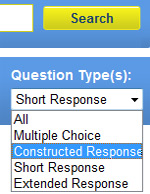
Using the SAS Assessment Creator you can use the "Question Type(s)" pull down menu to select questions that roughly correspond to Webb's Depth of Knowledge.
In general:
- Multiple Choice questions measure students' ability to recall facts and information
- Constructed Response questions measure students' skills and concepts
- Short Response questions measure students' strategic thinking
- Extended Response questions measure student's extended thinking.
Remember that you can always modify a question to measure the depth of knowledge you wish to assess.